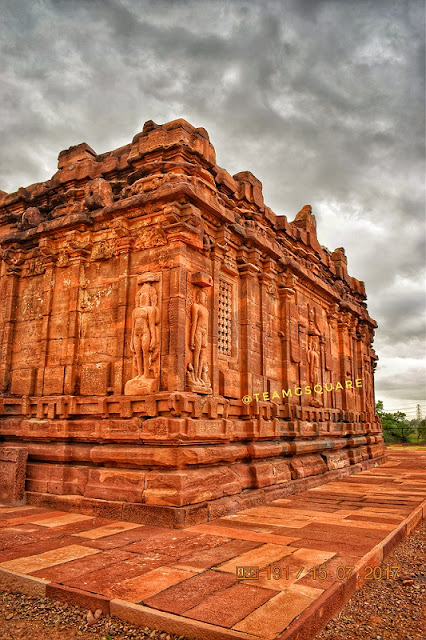
Saturday, February 3, 2018

A Unique and Rare Chalukyan Temple, Angur/Angoor, Ballari

Sri Kalleshwara swamy temple, Angur
Sri Kalleshwara Swamy Temple, Angur

Angur/Angoor, a small nondescript village on the banks of the river Tungabhadra is home to an obscure and rare Chalukyan temple dedicated to Lord Shiva. Reaching this temple in Angoor was as difficult as reaching the village itself. During our road trip of exploring the hidden gems on the banks of river Tungabhadra, we made a point to visit this temple dedicated to Sri Kalleshwara Swamy. We had to do some off-roading to reach this village from Magala and some search to reach the temple. To our shock and surprise, we found the entrance to this temple being locked for eternity. After inquiring with a few locals, we were advised to jump over the gate and enter if we wished to see the temple. I was a bit skeptical in doing so but with no option left, I forced myself and jumped over the gate to gain entry into this temple. However, it was only later that I found out about the conversion of one portion of the fence into a makeshift gate for the care taker's to entry into the temple premises.
Nine Banded Chalukyan Door Jamb
Beautifully Executed Seven Banded Door Jamb
Unique and Rare Chalukyan Temple
Note the Kirtimukha on the Vestibule of the Temple
Sri Kalleshwara Swamy Temple is a south facing trikuta temple dedicated to Lord Shiva in the form of a Linga, and Lords Janardhana and Surya built during 11th century by the Kalyani Chalukyas. Though not very impressive from outside as compared to the other temples built by Kalyani Chalukyas in the neighborhood, this temple has the distinction of being very unique owing to the presence of rare murtis of Lord Alingana Chandrashekaramurti, Daksha Mahaprabhu with his consort Prastuti and the god and goddess of eternal love, Rathi-Manmatha. The sheer presence of these murtis are itself very rare and their occurrence together is extremely significant. Daksha Mahaprabhu or Daksha Prajapati is one of the many Manasaputras (wish born sons) of Lord Brahma and is the father of Rathi (goddess of love) and Sati (one of the wives of Lord Shiva).  As per vedic beliefs, Daksha Mahaprabhu was allotted the work of developing/expanding the universe by Lord Brahma. Daksha Mahaprabhu is depicted with a Ram (male goat) head most commonly alongside with Lord Veerabhadra. There are very few temples dedicated to the love-god couple Rathi-Manmatha, but hardly any  dedicated to Daksha Mahaprabhu. Even the occurrence of Alingana Chandrashekaramurti is quite interesting since Lord Shiva is rarely worshipped in this form.
Lord Kalleshwara Swamy
Lord Surya
Lord Surya
Lord Janaradhana
Lord Janardhana
Alingana Chandrashekaramurti
Beautiful and Rare Murti of Alingana Chandrashekaramurti
Rathi-Manmatha God and Goddess of Love
Rathi-Manmatha
Lord Daksha Mahaprabhu with Consort Prastuti
Sri Kalleshwara Swamy Temple is thus very unique and must have been built to please these Lords in order to increase the population. These beautiful murtis along with those of Lord Ganesha, Goddesses of Saptamatrikas and Mahishasura Mardini, and Nandi are seen in the sabhamandapa. All the doors of this temple are finely carved. The door jambs of the garbhagriha consists of five sakhas (bands) decorated with various  flowers, creepers, animals, and musicians and that of the Mukhamandapa  consists of seven sakhas decorated with (1) lozenges (2) creeper-scrolls (3) flying mithunas (4) pilasters (5) square flowers (6) ropes and (7) petals. The outer wall is plain with the kapota having padma moulding on its underside and a curved top with semi circular designs. Above this is a plain course, a simple moulded course with blocks with another kapota having a sloping top and dentil projections carved with figures. The figures carved here include those of Lords Veenadhari Shiva, Bhairava,  Ganesha, Madhava, Narasimha, Goddess Saraswathi, the Ashtadikpalas, dancers, musicians, and others. While the history behind the construction of such a temple still  remains a mystery, deciphering the same will definitely add a lot more value to the current and future generations.  It is sad that this temple today is in oblivion and remains locked. Though the ASI has done a significant job of restoring this temple, it has failed to maintain and give it the respect it deserves.
Five Banded door frame Chalukyan style
5 banded Door Frame of Garbhagriha
Saptamatrikas
Nandi Murti
Veenadhari Shiva
Mahishasura Mardini in Chalukyan Architecture
Mahishasura Mardini
Places to Visit Around Angur: Hampi, Galaganatha, Chaudayyadanapura, Bellary, Sanganakallu, Haveri, Haralahalli, Magala, Ambali, Rangapura, Kurugodu, Gudekote, Bagali, Nilgunda, Havanur, Harihara, Kuruvatti and many such.

References:
1. A book " Temples of Karnataka" by Dr K M Suresh

Related Posts
1. Top 100 Lesser Known Temples of Karnataka 
2. Sri Kalleshwara Swamy Temple, Hire Hadagali
3. Sri Galageshwara temple, Galaganatha


Sunday, January 21, 2018

Sri Dattatreya Temple, Chattarki, Vijayapura

'Sri Dattatreya Temple' of Chattarki is one among the few Vaishnava temples built by the Kalyani Chalukyas. Chattarki is a small nondescript village in the Vijayapura/Bijapur district of Karnataka state. Vijayapura is a treasure trove of many lesser known temples built during the Kalyani Chalukya period, of which most are dedicated to Shaiva. Only 2 of the many temples built by the Kalyani Chalukyas in Vijayapura are dedicated to Vaishnava, the Sri Dattatreya Temple at Chattarki and the Sri Narasimha Swamy Temple at Vijayapura. The Dattatreya temple was built in the 12th century as per one of the inscriptions found here, which also refers this place to be an agrahara and a center for sculptural art and temple.
Sri Dattatreya Temple, Chattarki, Vijayapura
Sri Dattatreya Temple, Chattarki
Sri Dattatreya Temple, Chattarki, Bijapur
Full View of Sri Dattatreya Temple
Sri Dattatreya Temple, Chattarki, Bijapur
Skillfully Carved Mukhamandapa
Reaching Chattarki is not easy due to the limited availability of public transport. We had to hire an auto from Devara Hippargi to reach Chattarki. It is sad that the roads were devoid of any signage directing us to this temple and the final stretch of road too is in a  pretty bad condition. However on reaching, it felt good to see an enclosure in the form of a compound wall for protecting the temple. As I entered the temple complex, I wondered about how such a beautiful gem could lay hidden from the outside world. The temple is protected under the ASI, who have done a fair job in the temple's restoration and maintenance works. On interaction with the with the temple's priest cum caretaker, I  realized that not many people visit this temple which is why he was surprised that I came all the way from Bangalore. He went on to inquire if  I was involved in any research related to that temple and its architecture, for which I replied that my visit here was only out of personal interest!
Beautifully Decked Mukhamandapa
Navaranga Pillar of Sri Dattatreya Temple
One of the Pilasters of the Navaranga
Floral Carving on the Bhuvaneshwari
Madanikas Celestail Nymphs
 Celestial Scenes
Dancing Celestial Nymph
Dancing Madanikas Accompanying Lord Shiva 
Shilabalakis / Madanikas
The Mesmerizing Pose of Madanikas
Lord Vasudeva with Lord Brahma
Chalukyan Scultpures
A Hero Killing Lion
Goddess Chamundi
This temple consists of a garbhagriha, an antarala, and a sabhamandapa with mukhamandapa on three directions. The garbhagriha houses a murti of Lord Dattatreya on a high peetha, while the original murti of Lord Vishnu seems missing. The antarala is open, with two decorated circular pilasters. The sabhamandapa stands on four central pillars and twelve corresponding pilasters set against the walls. The central ceiling here has a beautiful carving of an inverted lotus bud with miniature sculptures. This temple has some fine carvings of sculptural beauty on its outer walls. Majority of these carvings depict Madanikas in different moods and action which are comparable to the Hoysalan style. There is a structure opposite to this temple that seems to belong to another temple about which the care taker had no idea. This temple too carries fine carvings similar to the Dattatreya temple.

Sri Dattatreya Temple, Chattarki
Ruined Temple with Damaged Carvings of Lord Vishnu and Madanikas
Framed

Places to Visit Around Chattarki: Vijayapura, Devara Hippargi, Indi, Sindigi, and many such.
How to reach Chattarki: Chattarki is about 35 km from Vijayapura, located off the Devara Hippargi - Indi Highway, about 13 km from D Hippargi.
Accommodation: There are no options for accommodation at Chattarki. It is better to treat Vijayapura as the base which offers various options to suit one's budget.
References: 
1. Book on 'Temples of Karnataka' by Dr K M Suresh
P.S: Nothing changes except our web address! We have moved from www.teamgsquare.blogspot.in to www.teamgsquare.com


Thursday, January 18, 2018

ಗುಡಿಬಂಡೆಯ ಕಥೆ/ The Story of Gudibande - A Short Movie

Our humble attempt to showcase another interesting fort at Gudibande via a short movie. This is as close as you can get to the fort! Hope you enjoy watching the video. 
The Story of 'Gudibande' dates back to the prehistoric times and its name is attributed to the temple embedded inside a rock, meaning "Temple rock". Do watch the video for the rest of the story. Also, kindly share and subscribe if you like.  


Friday, January 12, 2018

Sri Basaveshwara Temple, Hallur, Bagalkot

Sri Basaveshwara Temple, Hallur, Bagalkot
Sri Basaveshwara Temple, Hallur
'Sri Basaveshwara Temple' is another beautiful temple located in the village of Hallur. After visiting the Melgudi Jain temple, we proceeded towards the Basaveshwara temple located in the center of the village. It was good to find this temple live with daily worship of the deity. I was startled by fact that not many people were aware of this wonderful temple including the locals, and also the person who accompanied me. He was thankful to me for bringing him along to this beautiful temple dedicated to Lord Basavanna (Nandi). We inquired the priest about the temple's history, but he was only aware about the temple being at least 1300 years old.
Hallur Basaveshwara Temple
Full View of Sri Hallur Basaveshwara Temple
Chola Temple in Karnataka
Nandi Mandapa
As per the pre-independence Bombay Gazetteer (Bijapur was a part of Bombay State), this temple was built during 9th century by the Cholas. However  the book 'Temples of Karnataka' mentions this temple being built by the Rashtrakutas during the same period. Nevertheless to me, the temple seemed to exhibit more of the later Badami Chalukyan architecture. The original name of this temple was 'Vishvesvara Swamy Temple' which over time got transformed to Basaveshwara Temple. The temple consists of garbhagriha, an antarala, a sabhamandapa, mukhamandapa, Nandi mandapa and a prakara with a Rajagopuram. There are two colorful life-size sculptures of Shaiva dwarapalas guarding the entrance of the sabhamandapa. The Nandi mandapa houses a big and beautiful murti of Lord Basavanna.
Lord Basaveshwara, Nandi
Lord Basaveshwara
Life Sized Shaiva Dwarapala
Shaiva Dwarapala
Dravidian Shikara
Historical Temple near Bagalkot
The external walls of this temple are plain and decorated with pilasters. The lower potion of the walls carry carvings of various gods and goddesses like Brahma, Shiva, Vishnu, Varaha, Narasimha, Durga, and Mahishasuramardini to name a few, with most of them being in a damaged state. There are many houses around this temple, thus cramping the temple space. Though this temple is well maintained with prayers being offered and pujas being performed on a daily basis, it surely deserves more publicity to attract devotees seeking blessings of the Lord. The annual jatra is held during the months of December - January in reverence of the Lord. Also, the festival of Mahashivarathri is celebrated here in a grand manner.
Inscription Stone Slab
Bhu Varaha Swamy carved on temple wall
Bhu Varaha Swamy
Forms of Shiva
Ardhanareshwara and Gajasurasamhara Murti
Places to Visit Around Hallur: Kudala Sangama, Badami, Aihole, Pattadakal, Banashankari, Bewoor, Mahakoota, Shivyogi Mandir, Gudur and many such.  
How to reach Hallur: Hallur is located of f the Bagalkot - Kudala Sangama State Highway and is about 18 km from Bagalkot. 
Accommodation: There are no options for accommodation at Hallur. It is better to treat Bagalkot as the base which offers various options to suit one's budget. 
References: 
1. Book on 'Temples of Karnataka' by Dr K M Suresh
2. Bombay Gazetteer of Bijapur

Related Posts
1. Top 100 Lesser Known Temples of Karnataka 
2. Melguti Jain Temple, Aihole
3. Kalleshwara temple, Bethuru 

P.S: Nothing changes except our web address! We are moved from www.teamgsquare.blogspot.in to www.teamgsquare.com
 

Tuesday, January 9, 2018

Melgudi Jain/Jaina Temple, Hallur, Bagalkot

'Hallur' is a nondescript village located in the district of Bagalkot, off the Bagalkot - Kudala Sangama highway and can undoubtedly be considered as unusual and unique. Bagalkot, the Badami Chalukyan heart land is home to numerous temples built by the Cholas and Rashtrakutas around the 8th and 9th centuries AD. During one of my visits to Bagalkot, I got an opportunity of visiting the ancient temples of Hallur town. It was fascinating! The two prominent historic temples among them are those dedicated to Lord Basaveshwara built in 8th century by the Cholas and a Jain temple (popularly called Melgudi Jaina temple) built in 9th century by the Rashtrakutas. Hallur is located about 18 km from Bagalkot. Reaching this place was an easy task and as we reached, both the temples were easily visible.
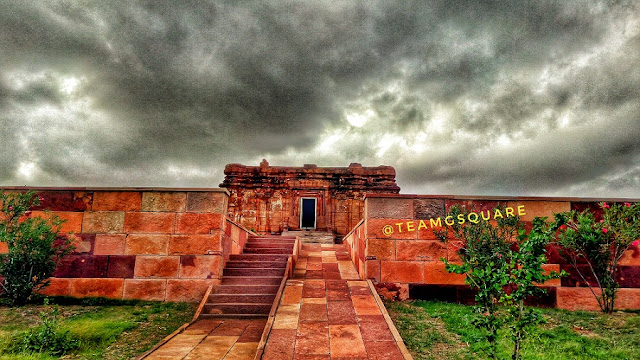
Melgudi Jain Temple, Hallur
First Look of Melgudi Jain Temple, Hallur
Melgudi Jain Temple, Hallur, Bagalkot
We chose to visit the Melgudi Jaina temple at first which is located atop a small hillock, thus giving it the name Melgudi. The temple is built on similar lines with the Meguti Temple at Aihole (7th century, Badami Chalukyas) with the only difference being that the navaranga here is a closed one. The Melgudi Jain temple was built around 870 AD during the reign of the most famous Rashtrakuta king, Amoghavarsha. This beautiful sandstone temple consists of a garbhagriha, an antarala and a navaranga/sabhamandapa, with an interesting stone ladder leading to the first storey that housing a small garbhagriha. The garbhagriha is originally believed to have consisted of a murti of a Jaina Tirthankara. However the temple now enshrines a Shiva Linga and Nandi along with a damaged inscription at its entrance which probably carried details of the installation of the same. The temple having been dedicated originally to a Jaina Tirthankara even now houses a murti of the same which is  kept in the sabhamandapa. But with no details with regards to why and when the original Jain temple was converted into a Shiva temple, the temple's history still remains a mystery. However, the  inscriptions may have carried information regarding the same, but it sadly remains damaged.
Inside the Garbhagriha
Typical Rashtrakutas Ceilings
Three Lotus Carving on the Central Ceiling
Murti of Jaina Tirthankara in the Navaranga
I climbed the small stone ladder that opens to the first storey only to find an empty garbhagriha. Being awestruck witnessing this small gudi (temple), I could only imagine as to how grand it would have been back then, during its full glory. That said, I strongly believe that my imagination would any day fall short of its true glory. After coming back to reality, I got down the ladder and decided to explore the external features of this temple. There are a total of 8 life-size carvings of various Jaina Tirthankaras on the outer walls of the temple. There are different kinds of Jalis (perforated stone windows) fixed in the outer walls. The details of the kutas (miniature shrine motifs), salas (oblong members with a wagon shaped roof), panjaras (shallow niches formed by pilasters) and makara toranas  are unfinished.
Small Gudi on the First Storey
A Jali Window/ Perforated Stone window of Rashtrakuta period
Jali Window
Life Sized Jain Tirthankaras are Carved on the Outer walls
Life-size Jaina Tirthankaras are Carved on the Outer Walls 
Historic Temple to visit near Bagalkot
Another View of the Melgudi Jain Temple
Detailing on the Outer walls
While closely observing the outer walls, I was dumbstruck to sight prehistoric kind of carvings on them! They were quite intriguing! Although I was able to identify many carvings such as those of the bulls, people and scenes of hunting, I have never witnessed something like this before and was unable to believe my eyes. The carvings here were pretty much similar to the ones at Sanganakallu. On further visual investigation as to whether these carvings belonged to the prehistoric period or not, I tried to trace the carving between two stones of the wall and found them to be discontinuous. Thus revealing that the carvings were made much before this temple was built. Sadly, a few insensitive idiots have tried to disfigure these carvings by their senseless graffiti. Thanks to god that some of these carvings have remained intact. I was unable to find much of literature/details about this temple. Once I was back in Bangalore from this trip, I re-looked at all the photographs taken by us during our previous visits to Badami, Pattadakal and Aihole. On careful observation and with a keen eye for detail, I found one of the pictures of Pattadakal having similar carvings of bulls and the only feeling I got was 'Wow'! Probably back then in October 2010, we were not versed with the prehistoric times and hence did not go ahead with the search for such carvings around with interest. However, may be during our next visit to this place, we would end up finding more about these carvings and many such! It is truly mysterious to have found such carvings on the temple walls and to further ascertain whether they are really prehistoric or not is very difficult at present. However the same can be achieved and confirmed by a thorough  and proper investigation and documentation. 
Southern Wall of the Temple
Prehistoric carving on Historic temple
Carving of a Bull
Proof of All the Vandalism and Ever Vanishing Evidences of Our  History
Bull Carving from Pattadakal
 To be continued...