Friday, June 3, 2022

Kurugodu Sri Dodda Basaveshwara Temple and Panchamukhi Veerabhadraswami Temple

Sri Dodda Basaveshwara Temple, Kurugodu
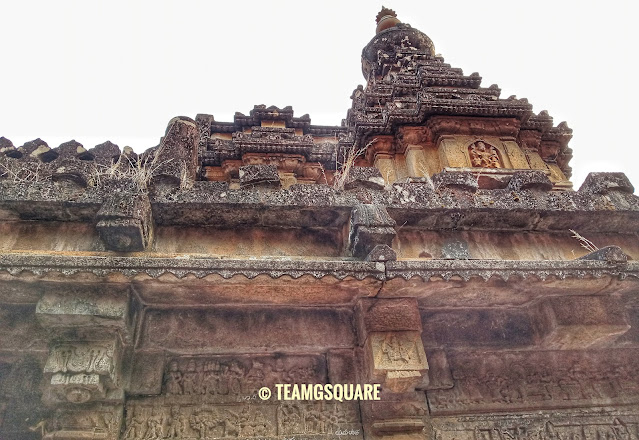
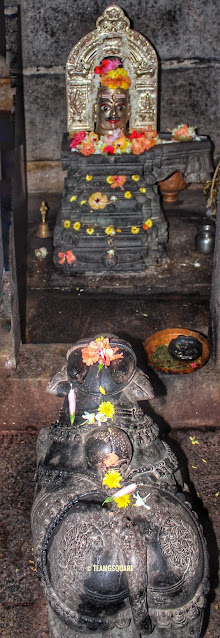
'Sri Dodda Basaveshwara Temple' of Kurugodu is the most revered of all temples here. One of its kind murti of lord Panchamukhi Veerabhadraswami is found here and is considered to be the most unique. After visiting various temples of Hale Kurugodu, we reached the Dodda Basaveshwara temple around noon. After seeking blessings of the Lord, we were served with Anna Prasadam  which happens here on a daily basis to all the devotees during the noon time. This temple is believed to have been constructed during the rule of the Vijayanagara kings. The temple complex is quite big, with a recently constructed Shikara and is dedicated to Lord Nandi or Basavanna, the vahana of Lord Shiva. The murti of Lord Basavanna is about 12 ft tall.The recent findings have revealed that the 'Bhavana Sangama', father of Harihara and Bukka (founders of the great Vijayanagara empire) belonged to Kurugodu.
Sri Dodda Basaveshwara Temple, Kurugodu
Nandi Pillar at the Entrance of Dodda Basaveshwara Temple
History of Kurugodu
Information About Kurugodu
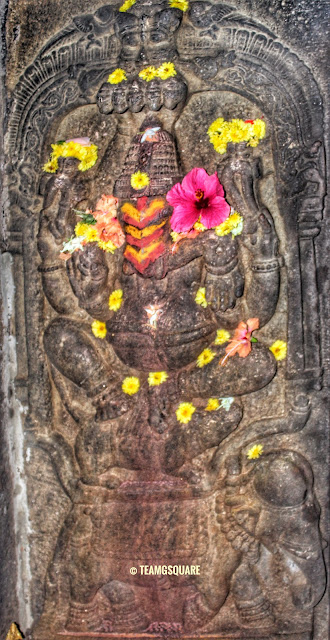
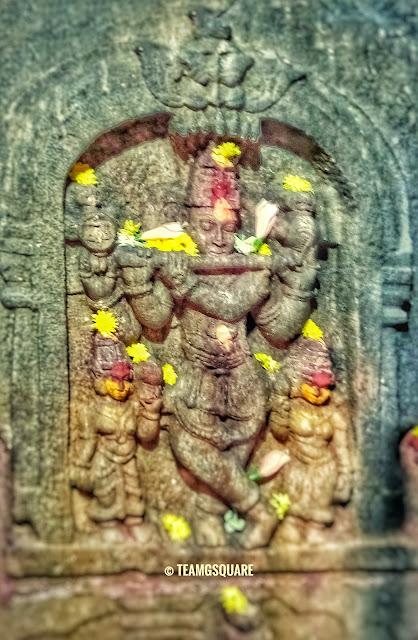
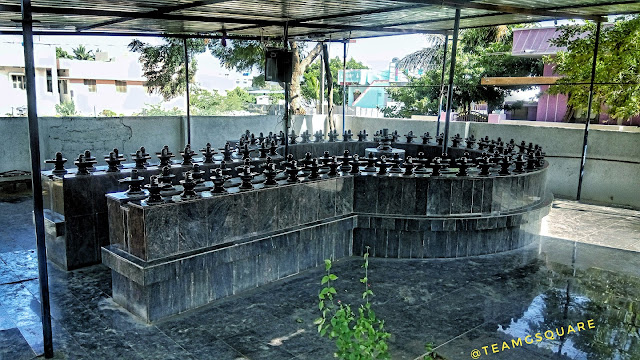
Hereon, we visited the Panchamukhi Veerabhadraswami temple which is located in the by-lanes of Kurugodu town.  This temple is completely renovated into a new structure. We visited the Sahasralinga complex besides the Veerabhadraswami temple. Though the main temple remained closed, we were able to have the darshana of the Lord, thanks to the grilled door . The Lord looked  divine with five faces and 12 hands, with Daksha Mahaprabhu standing besides him. It is rather an unusual depiction of the Lord Veerabhadraswami. There is a small murti of Lord Ganesha in the same garbhagriha. This temple is hardly known to many outside the town of Kurugodu.
Sahasralinga
Sahasralinga, Kurugodu
Rare and Unique Murti of Panchamukhi Veerabhadraswami, Kurugodu
Rare and Unique Murti of Panchamukhi Veerabhadraswami
How to Reach Kurugodu: Kurugodu is about 30 km from Ballari/Bellary. Take NH150A which connects Siriguppa to Bellary and then  take a  right turn at Dammur cross to reach Kurugodu. 
Accommodation: There are not many options available for accommodation in Kurugodu. However,  the best would be to find a stay in Bellary overnight. Our usual place of halt is Hotel Ashoka Residency with an affordable budget.
Places to Visit Around Kurugodu: Sandur, Kudatini, Sanganakallu, Bellary, Hampi, Nittur, Sirigeri, Siriguppa, Kenchanagudda, Kampli, Hirebenakal, Gudekote and many such. 

Wednesday, June 1, 2022

Sri Neelakanteshwara Temple, Madhusudana Ashrama, Jammatige, Koppa, Chikkamagaluru

Last time around, I had the opportunity to explore this small yet very beautiful temple near Sringeri, dedicated to Neelakanteshwara swami. About 2 km from Hariharapura is Jammatige, a small village located on the banks of the river Tunga. Jammatige is home to a very beautiful temple dedicated to Lord Neelakanteshwara, a form of Bhagwan Shiva. This temple was built in 1654 CE as per the Indian calendar year  (or 1732 CE as per the English calendar). The credit of building this temple goes to Kallanna, s/o Kolluranna of Kalasa, as per the inscriptions found here on the temple base (Adhisthana). A paper inscription dated 1774 regarding donations to this temple by Sri K H Rudraiyya of Holalakere was published by Dr. B Rajashekarappa. The temple authorities also have records of damages occurred to the temple due to floods from river Tunga in the 20th century and details of the restoration activity. Sri Neelakanteshwara temple is built in typical Keladi style, devoid of Navaranga and comprising only the Garbhagriha, Antarala, Mukhamantapa and Prakara, the outer wall that encloses the temple sanctum. The walls of this temple are adorned with carvings from various epics, puranas and scenes from daily lives of people.
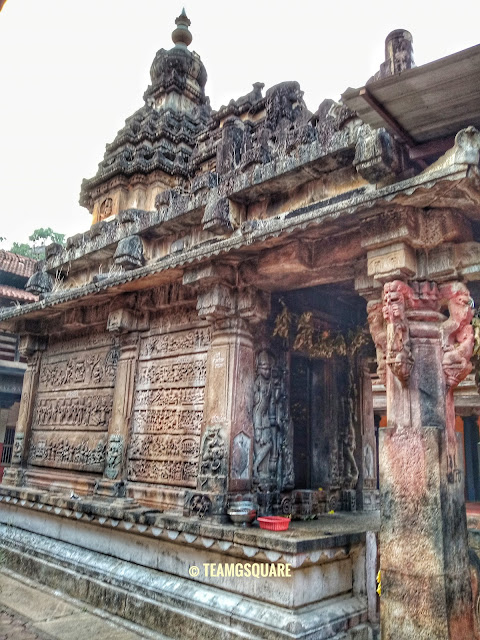
Sri Neelakanteshwara Temple, Jammatige

Shikhara
Details of Inscriptions found here
Sri Neelakanteshwara Swamy 

It was quite intriguing to witness Lord Ganesha atop his vahana, seated on an elephant howdah on one side and Goddess Durga on the other side, guarding the temple as dwarapalas of the garbhagriha. 
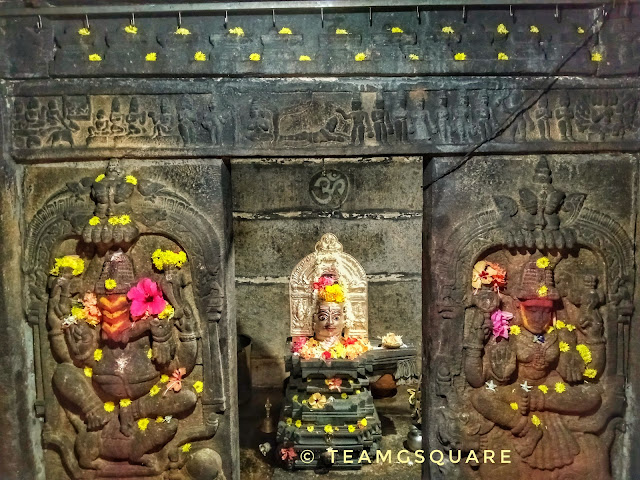
Door Frame of Garbhagriha 

Lord Ganesha seated on his Vahana on Elephant's Back

There are 2 friezes on the lintel of the Garbhagriha door - the top frieze carries carvings of Dwadasha (12) Jyothirlingas with a Nandi and the bottom frieze comprises of carvings depicting the story of  sage Valmiki along with the Saptharishis in Brahmaloka. 
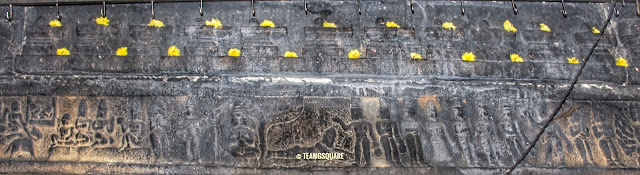
Friezes of the Lintel depicting Dwadasha Jyothirlingas and Valmiki Kathe

The inner walls of the Antarala are decorated with many interesting and unique carvings.

1.   A beautiful carving of Dashabhuja Chandra deva on a chariot run by 10 horses (Dashashwa ratha) and next to this is a carving of Brahma deva along with Saraswathi Devi seated on a peacock.
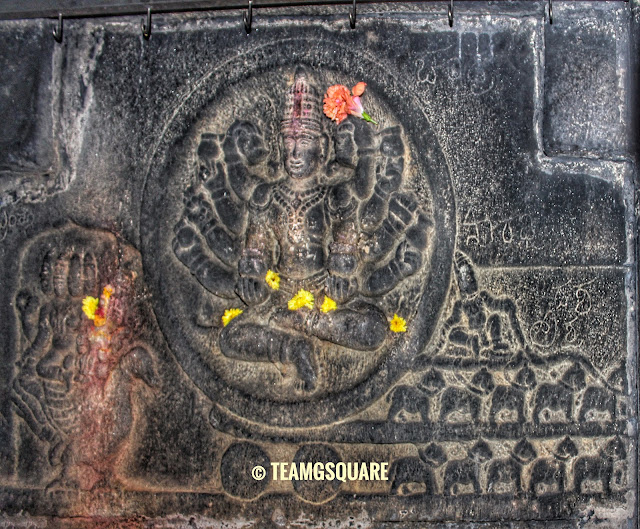
Chandra Deva 

2.    Carving of Chaturbhuja Surya deva on a chariot run by 7 horses with Aruna as his charioteer depicted with Mandeha, an asura who troubled Surya deva daily at dusk. Read more about it here.
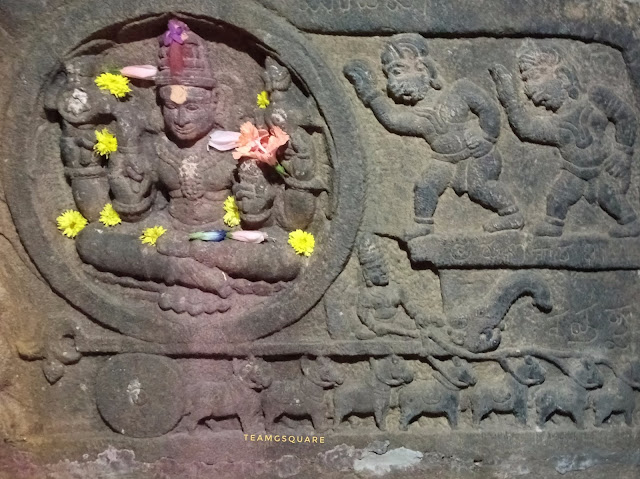
Surya Deva and his Chariot 

3.     A unique depiction of Lord Anjaneya and his son Makaradhwaja
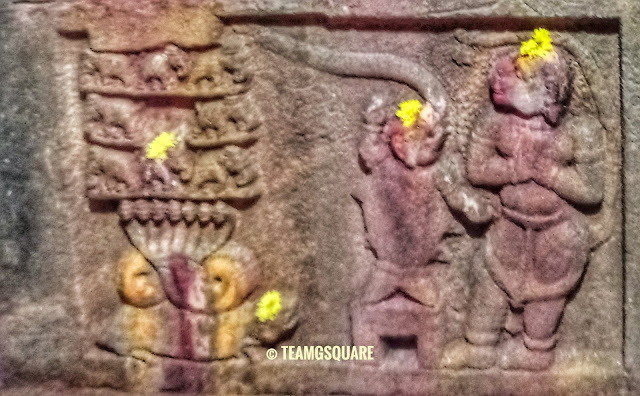
Lord Anjaneya and Makaradhwaja

4.     One more beautiful and unique depiction of Sapthaloka (Svarloka, Satyaloka, Tapoloka, Janaloka, Mahaloka, Bhuvarloka, Bhuloka) –  7 upper realms on  Asthadiggajja (Airavatha, Pundareeka, Vamana, Kumuda, Anjana, Pusphadanta, Sarwabhouma, Suprateeka  – 8 elephants holding eight cardinal directions of the world) supported by Adishesha and who in turn is seated on Kuruma.

Sapthaloka 

5.     Carving of Panchamukhi Brahma seated on a chariot.
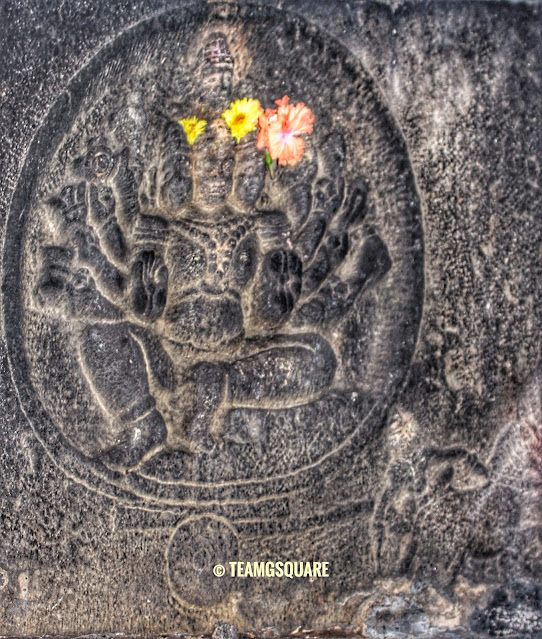
Panchamukhi Brahma Deva with Chariot 

6.     Gopalakrishna swami

Venugopala Swami

7.     Garuda Deva

Garuda Deva 

The front outer wall of  the Antarala carries a beautiful depiction of the beginning and  ending of Kaliyuga along with the Shaiva Dwarapalas.
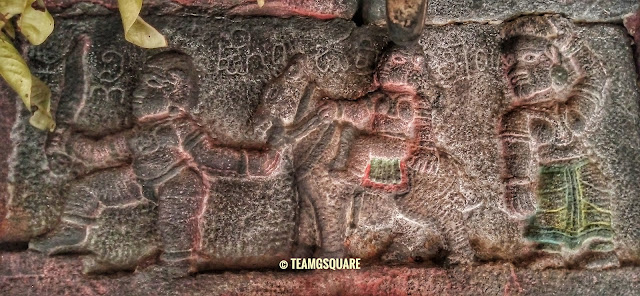
Beginning of Kaliyuga (when lust wins over righteousness)
End of Kaliyuga (when humans start eating other humans)

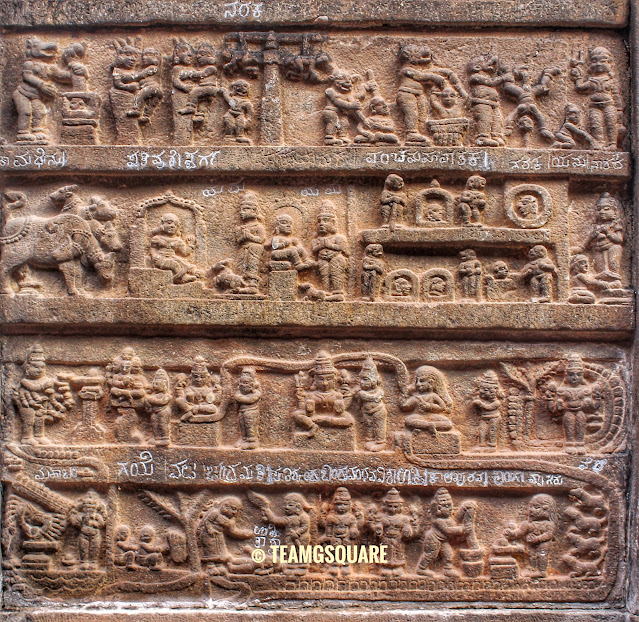
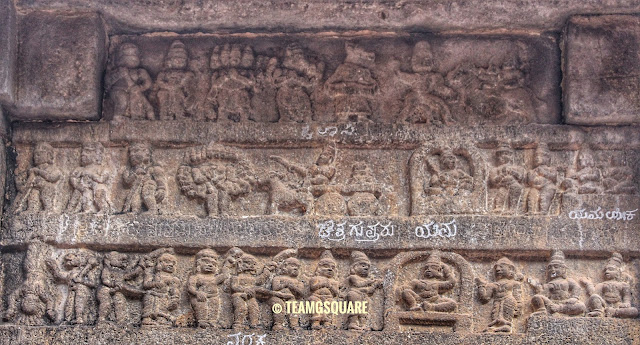
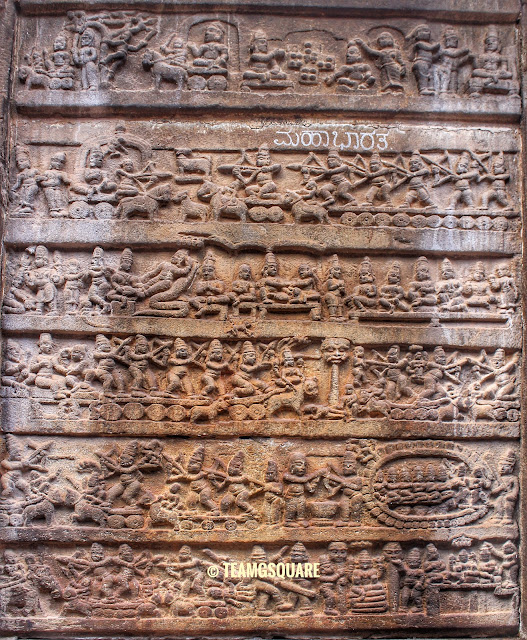
 The outer walls of the temples are adorned with carvings of the Dashavatara, Ramayana Katha, Bhagwat Purana, Mahabharata, Kailasaloka, Yamaloka and Naraka.
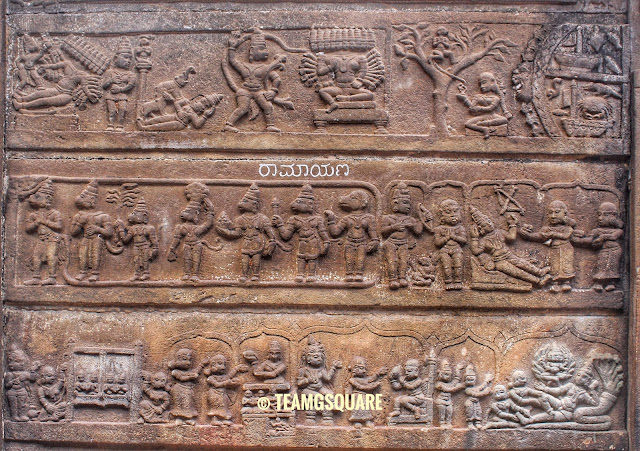
Ramayana Friezes 

Friezes Depicting Hell, Punishment in Hell and Story of River Ganga 

Kailasha and Yama Loka 

Mahabharata Friezes 

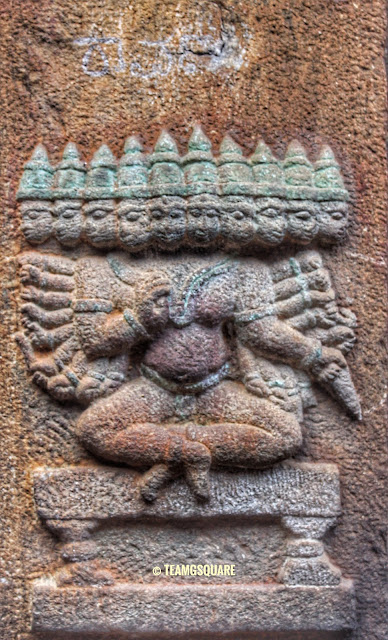
Asuraraja Ravana 

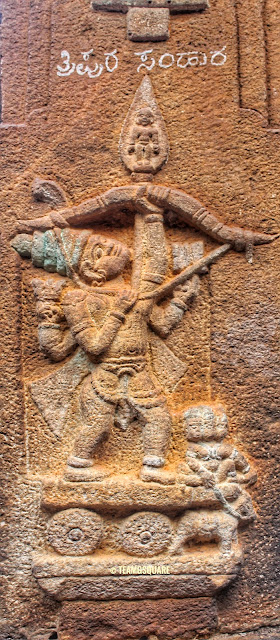
Tripura Samhara Shiva 

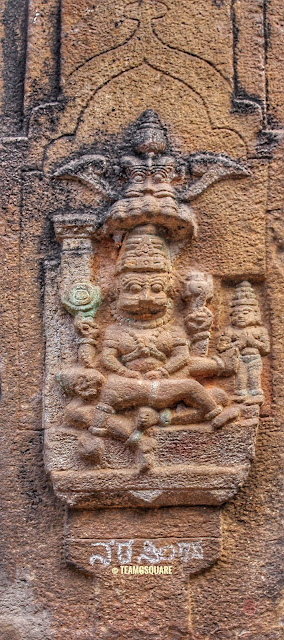
Ugra Narasimha Swami 
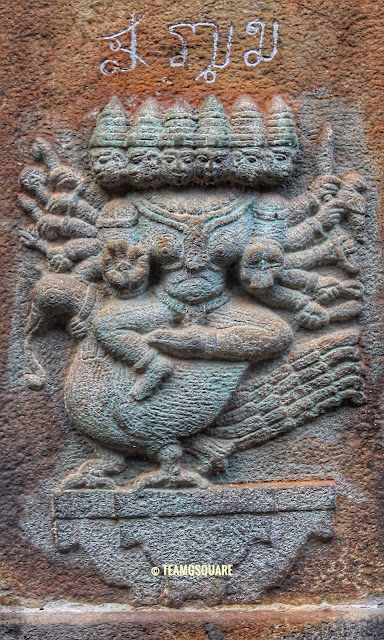
Shanmuga Swami 
References: 
2.  Chikkamagaluru Jilleya Itihasa Mathu Puratatva (Book by GoK)

Related Posts: 
Friday, June 18, 2021

Nagamalai Fort- A Lesser Known Fort Near Krishnagiri, A Good Weekend Trek From Bengaluru

The Mighty Hill - Nagamalai 

Our search for the twelve forts constituting the “Baramahal” or “the twelve Palaces” this time lead us to Nagamangalam, situated in Krishnagiri. We had spotted a hill fort from Jagadevi fort during our visit to that place but we were unable to explore this fort.  Finally, this year, on a fine Sunday morning we decided to explore this hill. After having a good breakfast at one of the hotels in Krishnagiri and packing enough food to survive during the trek, we headed towards Nagamangalam. Reaching this fort was easy as were aware of the location. Confirming the route again to the hill base with the locals to ensure we were on the right track, we reached the base of the hill fort. The locals helped us find the start point of the trek.

Nagamalai Fort 
Not much of the history of this forts seems to be documented in the English literature. The only reference we were able to find was the “Madras District Gazetteer - Salem”.  It is mentioned in this that Nagamangalam was one among the twelve palaces constituting “the Baramahal”. This information was sufficient for us to explore the fort. The fort seems to have been built during the rule of Channarayapatna Palegar, Sri Jagadevaraya who also built the fort at Jagadevi. Although the fort of Nagamangalam has more resemblance to Thattakaldurgam in terms of its location and architecture, the absence of any temple here signifies that it was built during Sri Jagadevaraya's rule, similar to the Fort of Jagadevi.

The trek initially is through the forest path after which we had to cross a small hillock to reach the base of the main hill. Hereon, the trek turned more adventurous. We had to climb a 70-degree inclined slope and without any proper route nor support while ascending, it was quite a challenge to overcome this stretch until we reached the ramparts of the fort. Here we were welcomed by a small door, probably used for emergency escape during any contingencies. Moving further along the walking path lead us to a point which deviated into two routes, one leading downwards and another leading upwards. We decided to take the downward route first to explore the main portions of the fort.

The Young Trekker

The Wild Trek Route
A nicely laid staircase led us downwards to the main entrance of the fort. Half-way down the staircase, we spotted the living area of the fortress on the other side. However, we wanted to explore the gateway area first and come back to exploring this later. The gateway here is very beautiful with Lord Ganesha sculpted on its lintel. Lord Ganesha seems to be the istha devata of Sri Jagadevaraya, which is quite evident across the forts built during his period. This fort gateway is associated with a building probably one that served as a guard’s room for the soldiers to rest. The top portion of the gateway made of brick and mortar seems like a later addition. After exploring the gateway, we walked along the ramparts to reach the living area of the fort.
The Slope

Enter The Dragon Moment 

The Well Laid Steps

The Gateway 

We headed straight towards the structure that looked like the base of a Mahal/ royal palace/ residence of army chieftain. This beautiful structure is made of locally sourced stones. Besides this structure is a huge granary. Further ahead are 2 structures resembling an armoury, a place to store gun powder and other ammunitions. There is a big rain water harvesting pond which probably was the main source of drinking water. The water here was clean and clear except for the fallen leaves. There is a big bastion overlooking this living place, which served as the vantage point to keep an eye on the enemies. This single tiered hill fort probably served more like a military outpost to Jagadevi fort. The Bastion gave clear view of Jagadevi fort; any attack over there seemed to have alerted the army here. We now halted for some rest and food under a shade.

The Remains of Palace

The Structures inside the Fortress

The Major Water Source
We emptied our packed food in no time since we were dead hungry. After resting for a while, we headed towards exploring the upper part of the fort and started to back track. We came across a beautiful carving of Lord Anjaneya on a stone. As we get down from here, there are remains of the foundation of a structure resembling a mantapa, the foundation or the base platform was seen having some carvings of animals. Now, it was time for us to start our descent.  While descending the 70-degree slope, we were very cautious and carefully got down the slope. Rest of the descent was uneventful.

The View From Big Bastion

Remains of Structure Probably Residence

The Other View of the Residence

Inside the Armoury 

The Ruins of Armoury

The Bastion 

The Mantapa

Kote Anjaneya Swamy
One of the interesting aspects of this place was finding a dolmen on the inclined slope. Although we did not sight or find any rock art or cave paintings apart from the dolmen, this place seemed perfect for prehistoric settlement owing to the presence of numerous caves and rock shelters. The Fort is well preserved naturally due to its location and not many people venturing here. The overall route is easy except for the slopy stretch, but is quite lengthy being about 8 km (to and fro).
Fort Gateway & The Trekker 
Related Posts: